In this article I provide a promotional-conversational but fact-checked review of Erofy and the nearest alternatives, based on facts
Don’t want to read right away, want to animate a photo online with AI? Then don’t waste time, go straight to the bot and test the result in a couple of minutes: @Erofy
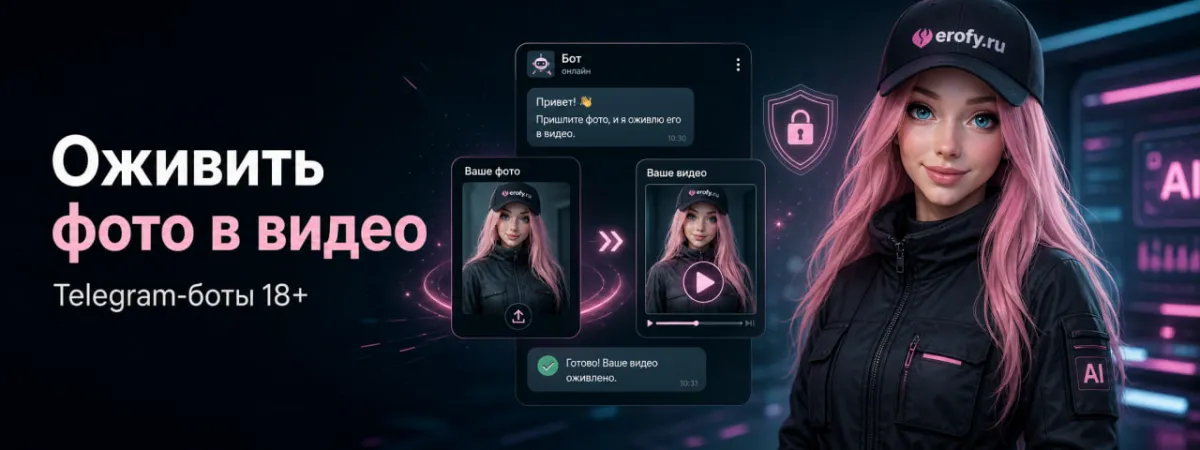
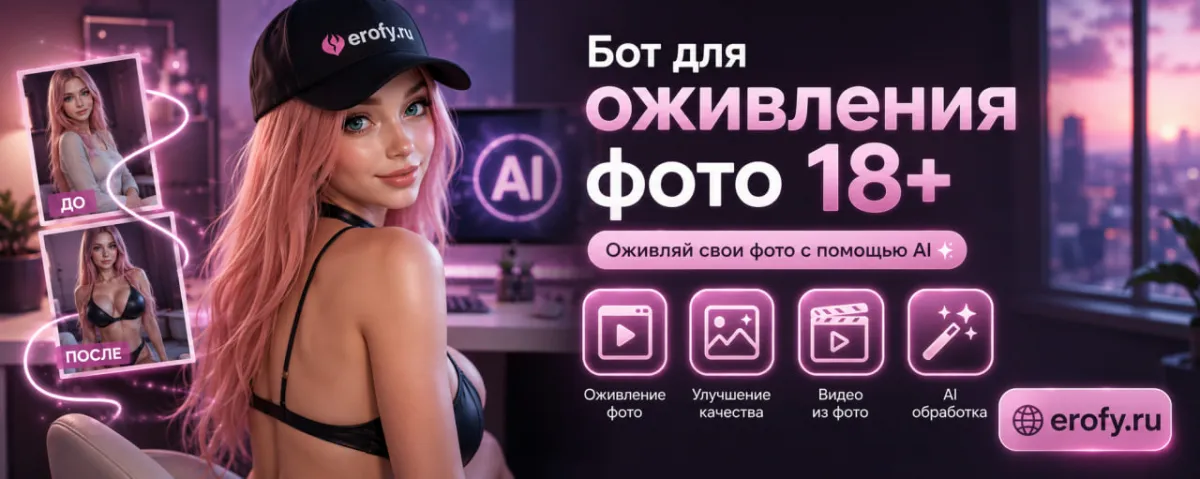
📌 It’s simple: upload a photo → get an animation → download the finished video.
Similar 18+ bots if you want more features, try also:
- @GoshaMenAI — photo animation and AI video creation
- @HotFoto — online image animation
- @NudsTop — AI undressing and photo transformation
- @ErofyHarem — AI chat and interactive content
👉 It’s best to test several options and choose the one that gives the best result
What is Erofy and what the official Telegram profile promises
Stripping away the fluff, Erofy in the public card is a bot for turning images into realistic videos with the claim “uncensored”. The monthly audience metric is also visible there and may change over time.
Russian-language catalogs usually describe Erofy as a tool for “photo animation and creation of 18+ visual content” right in Telegram, emphasizing speed/convenience. For example, FindMini notes that the project “works completely online” and also marks the card with the “Verified by developer” badge (in the catalog’s own terminology).
It is also useful that it directly adds a disclaimer on consent and privacy and describes Erofy as a freemium service in Telegram: basic functions may be available for free, while acceleration/extra features are paid; exact limits are recommended to be checked inside the bot.
How “photo animation” works and why the technology became massive
At the user level, “animate a photo” is when a neural network turns a static image into a short clip with light movements (facial expressions, turns, “living-frame effect”). This is exactly how AILibri describes the mechanism: recognition of key points and generation of intermediate frames for natural dynamics.
On the technical level, the market arrived at this through several waves of generative models:
- GAN approaches gave a powerful boost to photorealism in generation.
- Diffusion models (DDPM) established high quality and became the “workhorse” for mass generation.
- Latent Diffusion (diffusion in latent space) made high quality more accessible in terms of computation.
- Video models like Sora showed that video generation (including “from an image”) is no longer an experiment but a product-class technology
Why did this become “massive” specifically in Telegram? Because Telegram bots are simply accounts managed by software, and they conveniently wrap a complex model into understandable buttons and a fast scenario.
Why “18+ photo animation” became a separate niche
While neural networks were previously used mainly for image processing, the direction of 18+ photo animation online has now become an independent category.
The reason is that users are no longer satisfied with just a photo — they need dynamic content. Video holds attention longer, performs better in feeds and engages more strongly.
Queries like:
- animate 18+ photo online
- make video from photo uncensored
- ai photo animation 18+
are growing precisely because this is a fast way to get a “live” result without editing skills.
What neural networks for photo animation can really do
It is important to understand that “animation” hides not one tool but an entire set of technologies.
Modern AI models allow:
- adding head and body movement
- creating facial expressions and emotions
- imitating gaze and turns
- making short loop videos
- enhancing the “presence effect”
👉 As a result, the image feels like it “comes to life”, although it is a fully generated scene.
Animation formats: from simple to complex
Not all bots deliver the same result. There are usually several levels:
1. Basic animation
Light movement, minimal facial expressions, fast result.
👉 Suitable for tests and mass content
2. Enhanced animation
More noticeable movements, elaborated dynamics
👉 Can already be used in posts and advertising
3. Scenario generation
When the image turns almost into a scene with actions
👉 The most engaging format, but requires more resources
Why Telegram is the ideal environment for such bots
Telegram became the main platform for a reason.
First, it has a minimal entry threshold:
no need to register, download software or figure out interfaces.
Second, speed:
bots process requests quickly and immediately deliver the result in chat.
Third, ease of distribution:
any result can be sent straight to a channel or chat.
👉 That is why the query “animate photo in Telegram” now generates stable traffic.
Limitations and realistic expectations
Despite technological growth, it is important to understand the limitations:
- the result depends on the quality of the original photo
- the neural network may make mistakes in details
- it is not always perfectly realistic
- complex scenes require more time
👉 Therefore, it is better to treat this as a tool for quick content rather than perfect generation.
How to get the best result from AI
If you want the result to look as high-quality as possible:
- use clear images
- choose portrait photos
- avoid strong distortions
- test several bots
👉 Often the same file gives different results in different services
Format combinations: why users go further
An interesting point — users rarely stop at animation alone.
Usually the chain looks like this:
- Tried photo animation
- Moved to AI image processing
- Tried AI chat / models
👉 That is why it is important to show several categories in articles — this increases time on site and conversion.
Summary on the “18+ photo animation” niche
Photo animation is not just a trend but an already established market within AI content.
It combines:
- ease of use
- fast results
- high engagement level
And precisely because of this it continues to gain popularity in search and inside Telegram.