How to make a video from an 18+ photo prompt in Telegram
You need not just to animate the image, but to set movements and scene through text. This request is handled in one place — Telegram bots that accept both photo and description of the desired motion.
What prompt-based work provides
Regular animation only adds facial movement or light breathing. A prompt lets you specify a concrete action: head turn, body tilt, hand movement, pose change. The neural network builds missing frames from the description, not from a ready template.
Choosing the tool
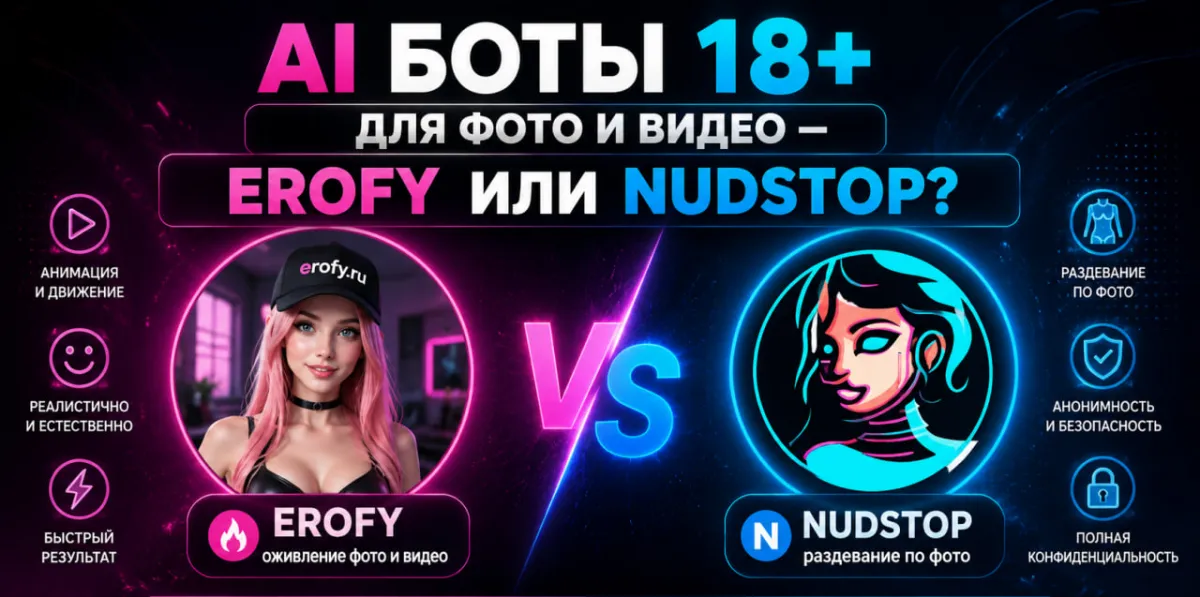
Bots that work with text and image simultaneously are suitable for generating video from a photo prompt. @Erofy — for simple scenes and quick testing. @Lab — when you need to set complex motion or an uncensored scene. @Animatephotos — if you want a more cinematic style result.
Preparing the source
The photo must be sharp, with a visible face and sufficient resolution. Frontal or three-quarter view works best, without strong shadows or obstructions. If the image is compressed or shot in dim light, the neural network understands pose and details worse.
Writing the prompt
The prompt is written after uploading the photo. The more precise the description, the closer the result matches expectations. Example prompts:
- “slow head turn to the right, looking at the camera”
- “slight forward body tilt, breathing, lip movement”
- “smooth hand movement along the body, pose change”
You can combine several actions in one description, but avoid overloading the text — the neural network handles 1–2 clear instructions better.
Starting generation
After sending the photo and text, the bot begins image analysis and motion model building. Processing takes 40 seconds to two minutes. While processing, a status is shown in the chat. When the video is ready, a download link or preview appears.
What to do if the result is unsatisfactory
If the motion looks unnatural or does not match the description, you can:
- change the prompt wording — make it shorter or more precise
- try a different angle of the original photo
- switch bots and compare results on the same image
Sometimes it is enough to remove extra details from the description so the neural network better understands the main motion.
Additional options
If you need to change clothing or pose in addition to motion, you can first process the photo through @UndreserAI, then send the result to the animation bot. This approach lets you obtain more complex content without multiple restarts.
What affects quality
- resolution and lighting of the original photo
- prompt accuracy — the more specific the description, the closer the result
- chosen bot — different algorithms give different levels of detail
- server queue — processing takes longer during peak load
After downloading, the video can be used for personal purposes. The main rule is not to publish materials without the consent of the people in the photo. The technology delivers results quickly, but the outcome always depends on the source and the accuracy of the description.
How to improve result accuracy
The quality of the final video depends not only on the prompt but also on the technical parameters of the original image. Before sending to the bot, check for compression artifacts, blurred areas, and unnecessary background objects. The cleaner the background and the more even the lighting, the lower the chance of distortions during motion generation.
Advanced prompt-writing techniques
To obtain more natural movements, you can add clarifications about speed and amplitude. For example, instead of “hand movement,” write “slow raise of the right hand to shoulder level.” Such details help the neural network correctly interpret the scale and direction of the action.
- “smooth head tilt forward 15–20 degrees”
- “gradual knee convergence, weight shift”
- “slow blink, slight backward body tilt”
Comparing animation styles across bots
Some Telegram bots focus on realistic motion, others on stylized or cinematic styles. If you need the most natural result, test 2–3 different tools on the same photo. The difference is often noticeable in facial expression rendering, skin texture, and smoothness of frame transitions.
Common prompt mistakes
One frequent issue is text that is too long or contradictory. If the description lists several complex actions at once, the neural network may “lose” some of them. It is better to break the task into stages: first set the basic motion, then refine the result if needed.
- avoid contradictions (“quick turn” + “slow movement”)
- do not specify exact time stamps (“after 3 seconds”)
- do not overload the prompt with clothing and background descriptions unless critical